Showing posts with label curriculum review. Show all posts

Tuesday, June 22, 2010

Considering God's Creation


I have found Considering God's Creation to be a wonderful science resource for us during the elementary grades. I had tried reading the encyclopedias and doing narrations as detailed in The Well-Trained Mind, but I couldn't seem to get it all together. Perhaps it required too much prep work for me? Probably!

Considering God's Creation provides a framework for study of natural science. The student workbook is full of creative activities and worksheets that reinforce what you are learning. The teacher's text gives you the exact words to say in teaching the lesson, and it gives other ideas to explore the subject covered. There isn't much guesswork, which is good for me!

This is a Christian curriculum that focuses on the truth of God's word and how that is reflected in science. This is a bonus for those who want to give their students tools to defend their faith.

The music CD is not a must-have, and we actually did not use it. If you can find it on Amazon or Ebay, then pick it up, but this is a science curriculum that will not break the budget!

Tuesday, June 15, 2010

Spelling

To be honest, spelling has not been an easy subject for me to teach. I have tried several different resources, and I think I have only recently settled on what works best for me. We have tried Spelling Workout workbooks and online games/resources for enrichment, but after starting Spelling Power with my younger daughter, I finally felt like we had found something that worked. I really like that this book will take my students all the way through their spelling studies - no other books to buy! I know others enjoy Sequential Spelling or simply use the spelling studies included in their traditional textbook curriculum.

Another more creative option that some parents use is developing spelling/vocabulary studies based on misspelled words in their writing or vocabulary words in their studies. You can look online for ideas or activities to reinforce spelling in this way.

It will be difficult to learn spelling rules without knowing phonics rules and without being able to read, so don't start spelling too early. Give every opportunity for success!
Have fun playing spelling games

Tuesday, June 8, 2010

Grammar & Writing

I started both of my girls in grammar studies using First Language Lessons, a very simple grammar study that focuses on the basics of English grammar and writing. My daughters memorized poems, learned the months of the year, memorized the definitions of the parts of speech, and explored narration. Even today I can start one of the memorized lists or definitions, and my daughters chime in with me!

At 3rd grade, I started formal grammar studies using Rod & Staff English. I absolutely LOVE this curriculum! It thoroughly covers grammar (including diagramming), AND it incorporates the development of writing skills including letters, book reports, poems, short stories, etc. I love the teacher's manuals that give me ideas on how to introduce the new concepts and provides a quick oral review before each lesson. Because it was created for classroom use, I usually don't have my students do all the exercises unless they are needed. But, I love that there are also worksheets that I can purchase to help when the exercises are not enough.

There are lots of other grammar curriculum out there, but when you find what you like, why change? All the major curriculum providers offer grammar studies - Abeka, Bob Jones, and Alpha Omega. There are also other programs that use non-traditional methods, such as Shurley English or Easy Grammar. Also, you can find many FREE resources online. Click here to view grammar links that I have collected.

Please be aware that many grammar curriculums do not include writing skills. You will have to incorporate writing in a different way or through an additional writing curriculum. Many people enjoy the Institute for Excellence in Writing and Writing Strands. Click here for other writing resources.

Tuesday, June 1, 2010

Elementary Math


Math curriculum choices are always the most difficult for me. I want to make sure I am giving my students the best possible opportunity to have good experiences with math. In addition, math curriculum is probably the most expensive part of any homeschool budget. So, this is one product I will not purchase without touching and feeling and reading through the materials.

My biggest issue with my first child was that most kindergarten curriculum seemed too simple - covering shapes, colors, and numbers with some basic addition/subtraction. Most of these concepts were already mastered with preschool activities and workbooks, and it seemed ridiculous to pay $100 for her to go through it all again. As I looked through the different offerings, I started looking for something that stayed simple and was easy for me to teach.

The first curriculum that most people review is Saxon Math which is similar to the math textbooks that we all grew up using. This is considered the "textbook method" where review is the game - you keep going back over learned concepts as you incorporate some new concepts a little at a time. There are lots of problems to work on, but they have started to incorporate hands-on activities as well. You will find similar math programs with all major curriculum providers such as Abeka, Bob Jones or Alpha Omega.

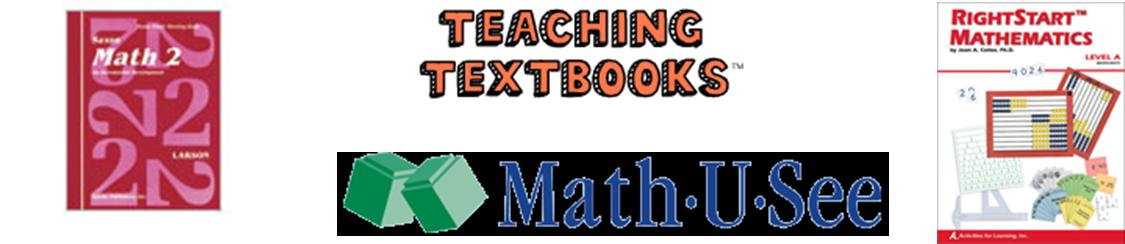
If the "textbook method" seems like too much for you or for your student, the next program to review is a math program that is more hands-on and interactive. These programs really appeal to teachers who have a hard time getting their students to enjoy math or sit still long enough to get a concept. They also save the teacher time with video and computer teacher options. Math U See is all about making math visual, and Teaching Textbooks is a fun computer software that leads your student through fun activities and visuals.

I ended up choosing the Right Start Math program which mixes visuals, games, and worksheets together to make a math program that is fun and engaging, but incorporates the written work needed for future math applications. The teacher must stay involved through the process, so it is not for those who need something that is independent for the student. You also have to trust the process since it does not introduce math concepts in a traditional way.

What if you can't pay $100 a year for math curriculum? Or what if you like to be creative or follow the unschooling method? There are wonderful websites and even learning games that can be used. Right Start Math has a Math Games book and cards that cover all the basic arithmetic needed for elementary grades. Cool Math 4 Kids is a FREE online math curriculum that can be incorporated as well. Don't forget the power of the internet for FREE resources, and you can check out my math links by clicking here. I use these links when my students need a little extra review or help.

I want to encourage you, most of all, to find a curriculum that makes sense to you; then, you will be able to adjust it for what your student needs. Also, take your time and don't feel like you have to rush through the materials. Elementary math is the basis, the foundation, and it needs to be built firmly not only for upper level math, but also for daily life!

Tuesday, May 25, 2010

Bible Studies


When homeschooling, many people make this educational choice for religious reasons. Although we feel strongly that we need to share our religious beliefs with our children, this was not the primary reason that we chose to homeschool.

Bible studies are an important part of our school day though. As a matter of fact, I schedule these times at the beginning of the day, so they are not skipped or rushed.

I have looked through Bible study curriculum for the younger ages, but I found most to be "watered down" and lack true substance. So, we started in first grade to read through the Bible - a chapter a day. I would read the chapter from a standard "adult" version and have my students draw a picture about our reading. My thought is that at least my children will not leave my house without having read through the entire Bible. I do not grade their pictures (though I do encourage that they have something to do with the reading), and as my older daughter moved into 3rd grade, I asked her to add a sentence or a few sentences to explain what she heard. You can also find printable coloring pages or crafts to go along with your Bible reading - click here for online resources that I have discovered.

I also use church activities to supplement our Bible reading - such as Scripture memorization. If your children's ministry does not encourage memorization, then look for fun resources at your local Christian bookstore.

We have a couple of Scripture memorization CD's and books that were gifts or that we purchased. My girls have enjoyed Steve Green's Hide'Em in Your Heart cd's, and we have found some scripture memory songbooks from Focus on the Family as well. Music is a great way to start the day too! Let them dance and sing while they learn foundational Christian truths. There are now DVD's that let you arrange a whole worship time with your children each morning. Check out Hillsong Kids for these wonderful resources.

Also, look for a local Awana chapter in your neighborhood. These clubs really encourage Scripture application as well as memorization in a fun and rewarding environment.

Putting all these things together will establish the foundation needed for them to begin discipleship studies in later grades. This is also an area where we want our students to have ownership, especially as they are older and leave home. I encourage you to gently lead and give them opportunities to build their individual faith and relationship with God.

Tuesday, May 18, 2010

First Language Lessons


As we move from preschool and kindergarten, I believe it is important to start laying the foundation of writing, and First Language Lessons provides a wonderful transition as parents move into 1st grade studies. Here is a brief explanation from the author's website:

"This one book is all you need to teach grammar for first and second grade. The lessons are short but effective; each one takes 5-15 minutes. The first 40 lessons are oral, since most first graders are not ready to do a lot of pencil-work. (There are enrichment exercises for those children who write easily.)

This book teaches grammar concepts in a gentle, yet thorough, way. In just minutes a day, two to three times per week, your child will learn eight parts of speech, the basic rules of capitalization and punctuation, the four types of sentences, and beginning storytelling and narration skills."

Before you go and get a formal English grammar study, I highly suggest that you try out this wonderful resource! It is very inexpensive for 2 years of study at less than $10 per year. It slowly introduces your student to grammar without the plethora of paperwork and written assignments.

I think you and your student will enjoy the poems, pictures, and simple lessons.

Tuesday, May 11, 2010

The Fun Part!


So, that ends our discussion of recommendations for preschool/kindergarten----"Wait! What about social studies, history, science, grammar, foreign language, and physics?"

OK, you are right. We don't want to have children who don't understand the laws of physics or don't know what a "president" is. This is actually the fun part! At this age, it is all about exposure in these areas. It is time to explore a fire station, see a cave, pick strawberries, visit science museums, and hear foreign languages spoken.

I would encourage you to stay away from boxed curriculum or textbooks - use your money and time to get out in the world. Let your child experience an art museum. Take them to a symphony performance. Find a support group that offers field trips and do it all!!! Get those passes to the zoo or museum, and take advantage of the classes that are offered for this age group. If money is tight, check out your local libraries for FREE classes and storytimes.

As far as arts and crafts go, you could simply focus on the holidays for each month. This helps your children begin to put the months of the year and the days of the week in order.

Explore the web for crafts and printables that teach about things you explore. If you go to the zoo and your student wants to learn more about elephants, find a coloring page or a mini-book to print and create. Some great sites include Homeschool Share, Kaboose, Homeschool Helper, and Family Fun. (The Family Fun magazine was a great resource of fun for us when our girls were younger!)

If you feel like you must have some formal text in these areas of study, I would suggest that you check out the Five in A Row series which uses picture books to explore these subjects.

Just remember that you are wanting to instill a love of learning at this age, and don't sweat the small stuff. If your child has the foundation of reading, writing, and understanding numbers, then he will be able to explore and learn about anything he desires, with or without your help.

Tuesday, May 4, 2010

RightStart Math


As we look at the needs of most PreK-K students, we have discussed Handwriting and Reading, and today we are going to focus on math skills. As with all the activities/curriculum I have introduced, I must emphasize again that you should take each subject slowly and consistently. At this age, there is no reason to push or try to simply get through a book. You need to make sure these foundations are strong.
I personally spent lots of time as a new homeschool mom looking at math programs. Math is not a subject that should involve hopping through different programs. Each curriculum has its own method and madness, and too much change can create confusion.

So, we started off with RightStart Math, and it has worked! I did hit some moments of uncertainty with my older daughter (who is now studying Algebra), but as I am going through the program with my second daughter, I am seeing the sequence more clearly. My favorite parts are the games included in the lessons, the "short and sweet" worksheets, the simple lessons, and the teacher's guide of what to say and do.

If your student is 4 years old or younger, you probably don't want to start a formal math program. There are so many other fun things that you can do to integrate math! You are mainly wanting to establish the relationship between the words and the symbols (numbers, colors, shapes). Click here for a few ideas.
Other options at this age for teaching the foundation of numbers, shapes, colors, and matching can include workbooks that you purchase at Walmart or Target. You can also download FREE worksheets or activities from these sites. Don't underestimate the fun of the kitchen either - a great way to help children visualize those numbers! They also love getting to eat the finished product!
As you move from recognition of the math symbols into relationships between the symbols (i.e. addition, subtraction), you may want to start looking for a math program. If you want something more structured like school textbooks, you may want to check out Saxon Math, or for something more visual and interactive, explore the Math U See program. There are many options out there, and I encourage you to find the one that makes the most sense to you as a teacher. RightStart Math is easy for me to teach. You can always adjust your curriculum to fit your child, but it is harder to explain something that you can't even understand yourself!!!

This is one area where I encourage you to beg or borrow a friend's program and try a few lessons before you make a purchase. Math curriculums and manipulatives are quite expensive. If you don't have a friend, attend a few homeschool conventions and visit every elementary math booth in the curriculum hall. Let them give you their presentation and touch and browse through the books thoroughly. This is great fun for you shoppers!
Again, the emphasis here is building a foundation, not becoming a math genius in a year. You want math to be fun and more like puzzles or games - not drudgery. When a child can clearly understand the symbols of math, then the introduction of math problems is not so strange or intimidating.
Tuesday, April 27, 2010

Teach Your Child to Read


Each Tuesday I am sharing resources that I recommend for PreK-K, and last week I discussed a Handwriting curriculum. In the Three R's (reading, writing, and arithmetic), one goal is to get your child on the right track as far as reading goes.

I have personally used Teach Your Child to Read in 100 Easy Lessons with both of my children starting roughly around 4 years of age. I learned some things with my first and incorporated those with my second for even better results! Let me share some of my tips about using this book and teaching reading in general:
  • Do not incorporate the handwriting exercises - it can be very frustrating for most children. See the Handwriting post for other resources.
  • Only do what your child can handle in one sitting - it is more important to do a little each day than it is to complete a whole lesson each day
  • Don't expect 100 EASY lessons - each child has her own struggles, so don't get frustrated
  • Be consistent - you want to develop a love of learning, but this love is only developed by exploring something every day
  • Make flashcards or purchase the flashcards for the sounds, and use them as a game - this can be done in place of a lesson when your student seems frustrated
  • When you have completed the lessons, don't forget to use the reading list in the back of the book to introduce your children to REAL books

There are many wonderful reading resources out there, and I chose this reading resource as my first option mainly due to the low cost. My thought was that if it worked, then I saved lots of money! Most of the other reading programs involve hundreds of dollars, especially if you purchase all the manipulatives, books, and supplemental materials. I did use A Beka's Handbook for Reading as a followup with my first child, and their early phonics program is highly recommended by even public school teachers. Another resource that is recommended is The Ordinary Parent's Guide to Teaching Reading which gives more phonics structure and involves more lessons.

If you want FREE resources for teaching reading, you will want to check out Starfall, an online phonics course. Also, you can visit my Delicious page here for links to other FREE online resources and phonics courses.

After establishing a student's phonics foundation, I encourage the reading of REAL books. As they start reading library books, they begin to feel confident in reading in every day life. There are so many wonderful stories and things to explore!

Once a child can read, they have the ability to learn anything. You have given them the tool to interact with and discover the world around them. If you never get to teach him science or history or economics or chemistry, he now has the ability to learn independently. So, don't give up and hang in there as you develop and deliver this wonderful gift to your child!

- originally published for Essential Church School

Sunday, April 25, 2010

Handwriting Without Tears


Handwriting Without Tears is a wonderful introduction to handwriting and to the "school" table as well! Whenever a mom of a 4 or 5 year old asks me what they should do to get their child on the right start for education, this is one of the first things I recommend.

The workbooks and hands-on tools help your student to develop hand-eye coordination at a slow and steady pace. The workbook pages are very simple and usually only require 5 minutes to complete. You can even make it more simple by doing only one thing on a page per day. The teacher's guides give some great ideas on how to introduce new things and how to correct bad habits.

In addition, this curriculum is not very expensive. The workbook and teacher's guide are under $10 each, and you can even splurge a little and get some of the manipulatives for fun! If even $10 is more than you can spend, consider visiting their website for FREE downloadable letter formation charts and videos to help you get your student on the right track.

I personally have used this with two of my children with wonderful results. The structure of the letters is very simple, and some people prefer the fancy handwriting books. I have discovered that my children develop their own fancy style as they get older, but I didn't have to struggle through making sure their loops were slanted at the right angle at age 7! Literally, NO TEARS!

Handwriting is preparation for grammar and for creative writing, and it gives your student a way to express himself. It is not the end of the world if he doesn't have the most beautiful and structured letters. Your main goal is legibility, so sit back and relax as he learns at his own pace. Just keep giving him experiences and opportunities to learn and grow.

-originally published on 4/20/2010 for Essential Church School